

Tree diagrams can be used to find the probabilities for two events, when the outcomes are not necessarily equally likely.
Worked Examples
If the probability that it rains on any day is , draw a tree diagram and find the probability
The tree diagram shows all the possible outcomes. Then the probability of each event can be placed on the appropriate branch of the tree. The probability of no rain is 1 − = .
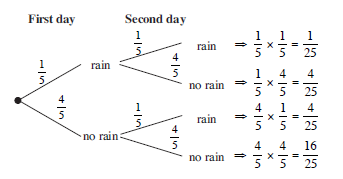
The probability of each outcome is obtained by multiplying together the probabilities on the branches leading to that outcome. For rain on the first day, but not on the second, the probability is
× =
that it rains on two consecutive days,

The probability that it rains on two consecutive days is given by the top set of branches, and is .
that it rains on only one of two consecutive days.
There are two outcomes where there is rain on only one of the two days. These are rain – no-rain, with a probability of and no-rain – rain with a probability of .
The probability of rain on only one day is found by adding these two probabilities together:
+ =
The probability that Jenny is late for school is 0.3. Find the probability that on two consecutive days she is:
The tree diagram shows the possible outcomes and their probabilities. Note that the probability of not being late is 1 − 0.3 = 0.7.

The probabilities on each set of branches are multiplied together to give the probability of that outcome.
never late,
The probability that Jenny is never late is given by the bottom set of branches and has probability 0.49.
late only once.
The probability that she is late once is given by the two middle sets of branches which both have a probability 0.21. So the probability that she is late once is given by
0.21 + 0.21 = 0.42
Note
The method shown here also works for problems when the outcomes are equally likely (as in the previous method) – it is sometimes rather cumbersome though to draw all the branches.
The next example is the same as Worked Example 2 in Section D2.2, but this time the tree diagram method will be used.

A spinner that forms part of a children's game can point to one of four regions, A, B, C or D, when spun. What is the probability that when two children spin the spinner, it points to the same letter?
This time, let us use the tree diagram approach.
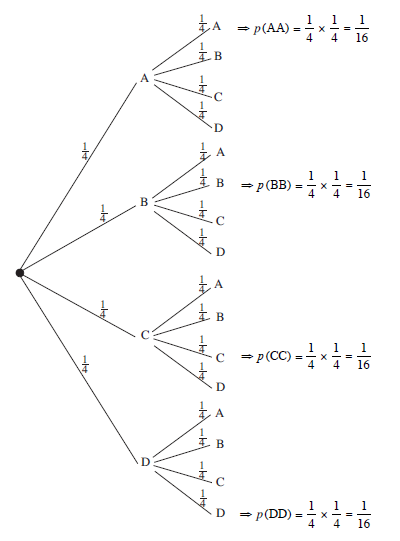
So the probability of both children obtaining the same letter is
+ + + = (as obtained before)
Exercises
