

An enlargement is a transformation which enlarges (or reduces) the size of an image. Each enlargement is described in terms of a centre of enlargement and a scale factor.
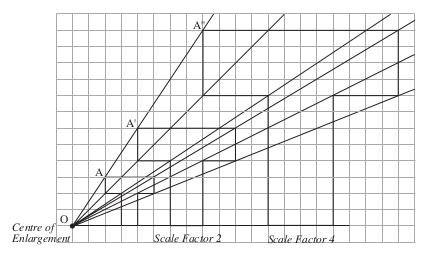
The example shows how the original, A, was enlarged with scale factors 2 and 4. A line from the centre of enlargement passes through the corresponding vertex of each image.
Note
The distances, OA′ and OA′′, are related to OA:
OA′ = 2 × OA
OA′′ = 4 × OA
The same is true of all the other distances between O and corresponding points on the images.
Worked Examples
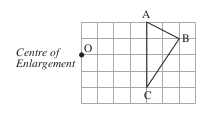
Enlarge the triangle shown using the centre of enlargement marked and scale factor 3.

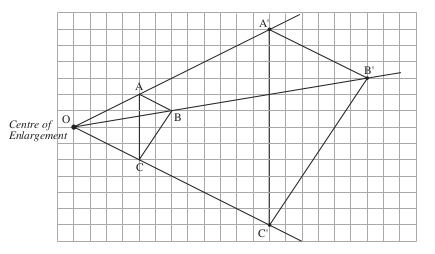
The first step is to draw lines from the centre of enlargement through each vertex of the triangle as shown below.

As the scale factor is 3, then
OA′ = 3 × OA
OB′ = 3 × OB
OC′ = 3 × OC
The points A′, B′ and C′ have also been marked on the diagram. Once these points have been found they can be used to draw the enlarged triangle.
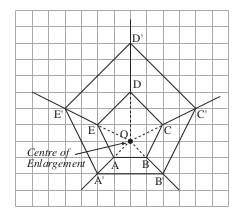
Enlarge the pentagon with scale factor 2 using the centre of enlargement marked on the diagram.
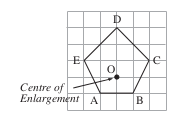
The first step is to draw lines from the centre of enlargement which pass through the five vertices of the pentagon.
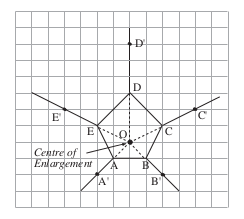
As the scale factor is 2 the distances from the centre of enlargement to the vertices of the image will be
OA′ = 2 × OA
OB′ = 2 × OB
OC′ = 2 × OC
OD′ = 2 × OD
OE′ = 2 × OE.
These points can then be marked and joined to give the enlargement.
The diagram shows the square ABCD which has been enlarged to give the squares A′B′C′D′ and A′′B′′C′′D′′ .
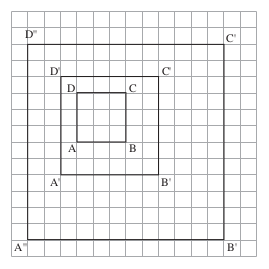
Find the scale factor for each enlargement.
The sides of the square ABCD are each 1.5 cm. The sides of the square A′B′C′D′ are 3 cm. As these are twice as long as the original, the scale factor for this enlargement is 2.
The sides of the square A′′B′′C′′D′′ are 6 cm, which is 4 times longer than the original square. So the scale factor for this enlargement is 4.
Find the centre of enlargement.
To find the centre of enlargement draw lines through A, A′ and A′′ , then repeat for B, B′ and B′′ , C, C′ and C′′ and D, D′ and D′′.

These lines cross at the centre of enlargement as shown in the diagram.
Note
When the scale factor of an enlargement is a fraction, the size of the enlargement is reduced. The image of the original is then between the centre of enlargement and the original.
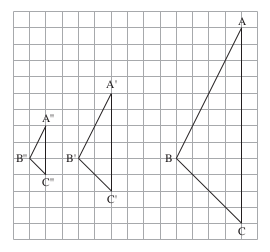
The diagram shows three triangles. ABC was enlarged with different scale factors to give A′B′C′ and A′′B′′C′′.
Find the centre of enlargement.
To find the centre of enlargement, lines should be drawn through the corresponding points on each figure.
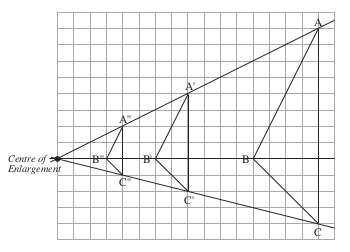
Find the scale factor for each enlargement.
To find the scale factors, compare the lengths of sides in the different triangles. First consider triangles ABC and A′B′C′ :
AC = 6 cm and A′C′ = 3 cm,
so
A′C′ = × AC
which means that the scale factor is .
For triangles ABC and A′′B′′C′′,
AC = 6 cm and A′′C′′ = 1.5 cm,
so
A′′C′′ = × AC
which means that the scale factor is .
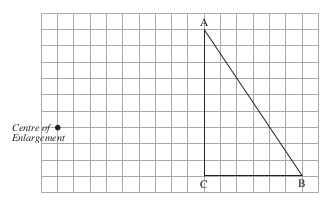
Enlarge the triangle shown with scale factor and centre of enlargement as shown.
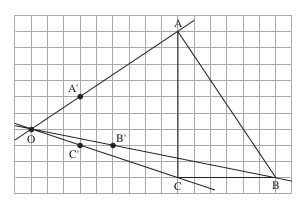
The first stage is to draw lines from each corner of the triangle through the centre of enlargement.
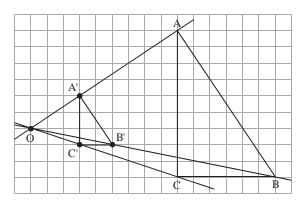
These points can then be joined to give the image.
Then the corners of the image should be fixed so that
OA′ = × OA
OB′ = × OB
OC′ = × OC
Exercises
