

Vectors are used in Unit 36 to describe translations. The diagram shows the translation of a triangle by the vector .
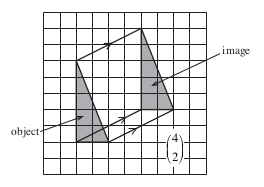
Note that the vector specifies how far the triangle is to be moved and the direction, i.e. 4 units horizontally (to the right) and 2 units vertically (up).
All vectors have length (or size) and direction. Quantities which do not have direction, but only length or size are known as scalar quantities. Quantities like mass, length, area and speed are scalars because they have size only, while quantities like force and velocity are vectors because they have a direction as well as a size.
The two points A and B are shown in the diagram. The displacement (change of position) of B from A is a vector because it has length and a direction.
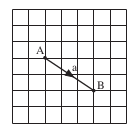
We can write this displacement as AB = or label the vector a and write
a = AB or a = and in this format, it is called a column vector.
The notation a is used when a is a vector and the notation a is used when a is a scalar.
The length of a vector is called its magnitude or modulus: we write this as |a| .
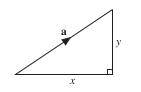
If a = , then, using Pythagoras' Theorem,
So for the vector a = , |a| = = =
Vectors can simply be added and subtracted.
Consider + which can be represented as shown in the following diagram.
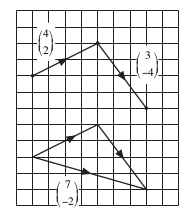
So, from the diagram, the addition of these two vectors can be written as a single vector , which is just the addition of each component of the original vector. In general,
A similar result is true for subtraction,
A vector can be multiplied by a scalar, i.e. a number, by multiplying each component by that scalar.
For example, 4 × = .
In general,
Worked Examples
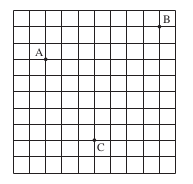
Write each of the following vectors in the form .
 =
=
=
=
=
=
Note
In the Worked Example above, we see that
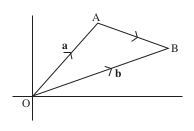
This is always true so that, for example,
OA + AB = OB
or
| a + AB | = b |
| AB | = b − a |
Similarly,
BA = a − b
as the direction is the opposite of AB.
If a = , b = and c = find:
= 2 × = =
= + = =
= − = =
= 2 × + 3 × = + = + = =
Note
When the vector starts at the origin, it is called a position vector.
OA and OB are position vectors relative to the origin, O. Given the points A(3, 1) and B(−1, −2)
write down OA and OB as column vectors
OA =
OB =
express AB as a column vector
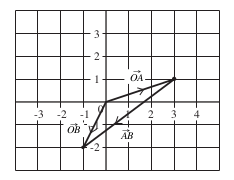
As OA + AB = OB,
AB = OB − OA = − =
This can be seen in the diagram opposite.
calculate the length of AB.
| |OB| | = |
| = | |
| = | |
| = 5 |
Exercises
